
Why direct debit is the standard for gyms
With direct debit, the monthly fee is collected without anyone sending an invoice. Your team spends less time on admin, and members do not have to remember to pay. Payments arrive on time more often, and your income becomes easier to plan.
The cost of manual payment is hidden: time spent on reminders, awkward conversations at the desk and fees that arrive late.
In Dialanta, this is what Memberships and direct debit is for.
Step 1: choose a payment provider
Choose a payment provider that fits your club and your country. Dialanta connects to the payment provider your club already uses. Pick the one you know or that your bank or accountant prefers.
Step 2: keep every member and subscription in one file
Members, subscriptions and payments should live together. When your team opens a member, they should see the subscription, the payments and the history in the same place. This avoids mistakes and saves time.
Step 3: let people sign up online
Online sign-up lets a person become a member at any time, also when the desk is closed. A pre-filled sign-up link makes it even easier: your team sends the link with the person's details already in place, and the person only has to confirm.
Step 4: do not lose failed payments
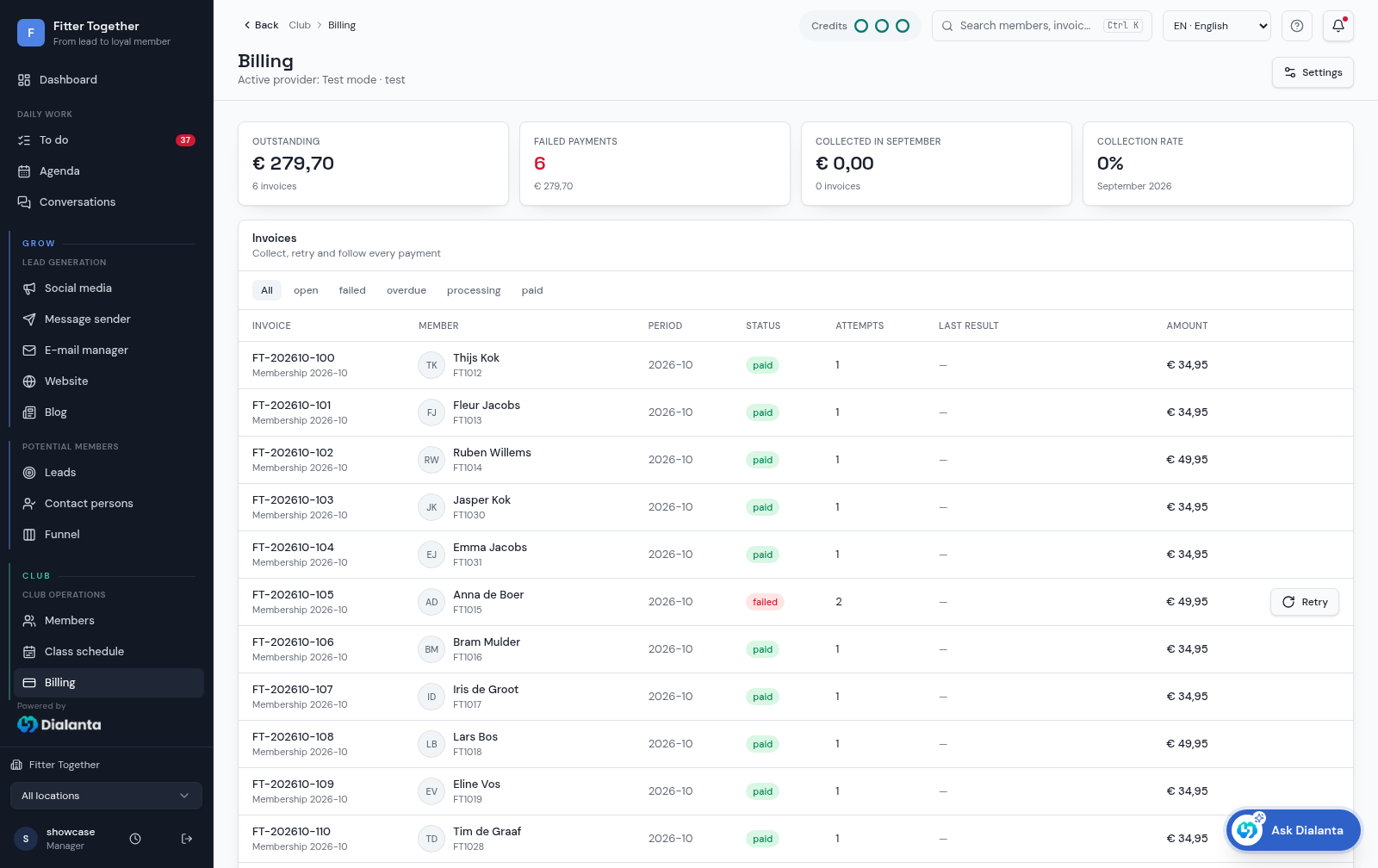
Some payments fail. If nobody follows up, the money is lost and the member may not know. Make every failed payment a task for a named colleague.
Contact the member in a friendly way. Most failed payments have a simple reason and can be solved with one message.
- Put failed payments in a task list.
- Give each task to a named colleague.
- Contact the member in a friendly way.
- Record what was agreed on the member's card.
Step 5: make freezing simple
Members sometimes need to pause. Let any staff member freeze a membership, and send member requests to reception. A quick answer keeps the member with you, while a slow one makes them cancel.
Step 6: connect payments to retention
Payments tell you about members. A member who stops paying, or whose contract is about to end, needs attention. When payments, visits and contracts are in one place, your team can act before the member leaves.
A checklist for your club
Use this short list to see how your club is doing. If the answer to most questions is no, there is work to win.
Go through the list with your team once and write down who is responsible for each point.
- Are all members and subscriptions in one file?
- Can a person sign up online?
- Is every failed payment a task with a name?
- Can any staff member freeze a membership?
- Do member requests go to reception?
- Does your team see contract endings in time?
Common mistakes to avoid
The first mistake is keeping payments in a separate system that nobody checks. The second is handling failed payments by chance, when somebody remembers. The third is making freezing a long process, which pushes members to cancel. The last is changing the way you collect fees without telling members: explain what happens and when, and keep your tone friendly.
Your first month: a quick start plan
In the first week, put all members and subscriptions in one file, so your team no longer searches in several lists. In the second week, switch on online sign-up and test a pre-filled sign-up link yourself, from start to end. In the third week, agree how failed payments are handled: who gets the task, what the first message says and what happens if the member does not answer.
In the fourth week, agree how freezing works and who may do it. Write the rules on one page and share it with your team. When everyone knows the rules, members get the same answer from every colleague, and they notice the difference. Review the rules after a month and change what does not work.
How Dialanta helps
Memberships and direct debit are part of Dialanta Club.