

Why members cancel
Members leave for many reasons. Some lose their routine. Some do not feel part of the club. Some have a problem that nobody knew about, such as a class that does not fit or a payment that failed. Most of these problems can be fixed if you hear about them in time.
The cancellation itself is the last step. The first steps happen weeks earlier, when a member starts to come less often.
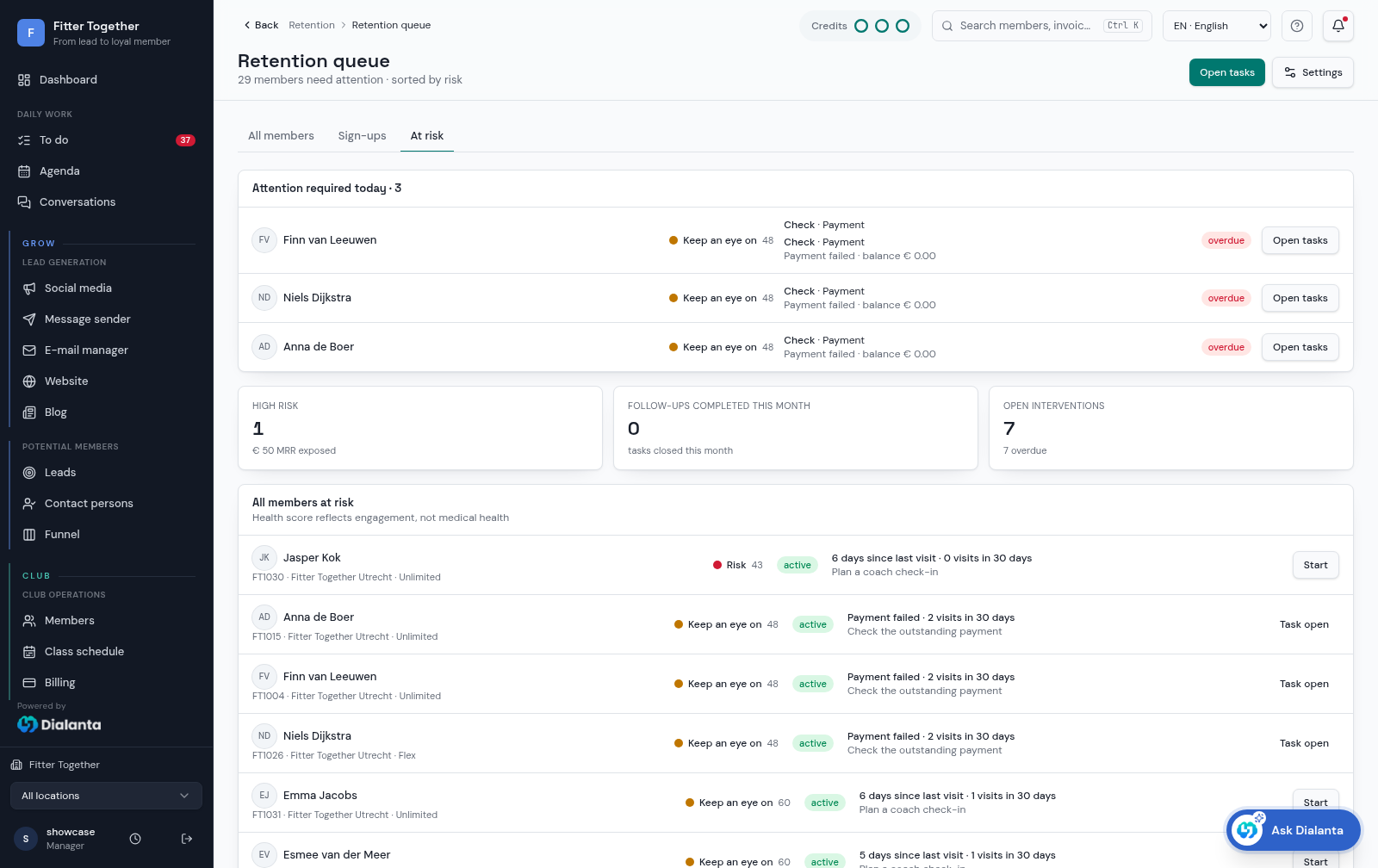
In Dialanta, this is what Retention is for.
Step 1: watch for the first signs
A member who visits less often is often a member who is thinking about leaving. If you only notice at the cancellation, it is usually too late.
Keep visits, payments and contract dates in one place, so your team can see who needs attention without searching in several lists.
- Fewer visits than before.
- A failed or open payment.
- A contract that is about to end.
- A low score in class feedback.
Step 2: reach out early and personally
A short, friendly message from a coach works better than a standard reminder. Ask how training is going and offer help. Do not sell. Show that you noticed.
Give every outreach to a named colleague, so it does not get lost. A task with a name on it gets done; a task for everybody does not.
Step 3: message first, then call
Start with a message on the channel the member reads, often WhatsApp. If there is no answer, call. A short call often tells you more than three messages. Write down what the member said, so the next colleague knows the story.
Step 4: fix what you hear
When members tell you what is wrong, act on it. A class at the wrong time, an instructor who does not fit, a payment that failed: each of these can be solved. Tell the member what you did, because it shows that you listen.
Ask for feedback on classes and instructors on a regular basis. A low score is a gift: it tells you what to fix before more members leave.
Step 5: make freezing easy
Members sometimes need to pause because of an injury, travel or a busy time. If freezing is easy, they stay members. If it is hard, they cancel. Let any staff member freeze a membership, and send member requests to reception.
Step 6: win members back
Members who have left can still return. A message some weeks after they leave, when it feels natural, gives them an easy way back. Repeat the offer later, with a different reason to come. Keep it friendly and without pressure.
A weekly routine for your team
Cancellations are easier to prevent when the work is small and regular. Set a fixed moment each week when your team looks at who needs attention. Open the list, divide the names between colleagues and agree who contacts whom.
Keep the routine short. Fifteen minutes with a clear list works better than a long meeting without one. At the end, check what was done last week and what the members said.
- Look at who visits less often.
- Look at open payments and contracts that end soon.
- Give each member a named colleague.
- Message first, then call.
- Record the answer on the member's card.
What not to do
Do not wait for the member to speak first. Do not send the same standard message to everybody. Do not offer a discount before you know the reason: many members leave for reasons that a discount does not solve. Listen first, then decide what to offer.
Your first week: a quick start plan
Start small. On the first day, list the members who have not visited for some time and the members whose contract ends soon. On the second day, divide the names between your coaches and your desk team. From the third day, send a friendly message to each member on your list and call those who do not answer.
At the end of the week, sit down for a few minutes. How many members answered? What did they say? Which problems came back more than once? Write the answers down and fix the one that appears most often. Next week, do it again. A simple routine, repeated, protects more memberships than a big plan that nobody follows.
How Dialanta helps
Dialanta Club helps you see who is about to quit and act on it, from one place.